
On the Air at wfarc.org: Building the West Fork Amateur Radio Club's New Home
The West Fork Amateur Radio Club keeps Wise County connected when the weather turns and the phones go down. We built them a website that works as hard as they do. Here's the club, the problem, and how AI-empowered development puts enterprise-grade tools within reach of every nonprofit and small business.
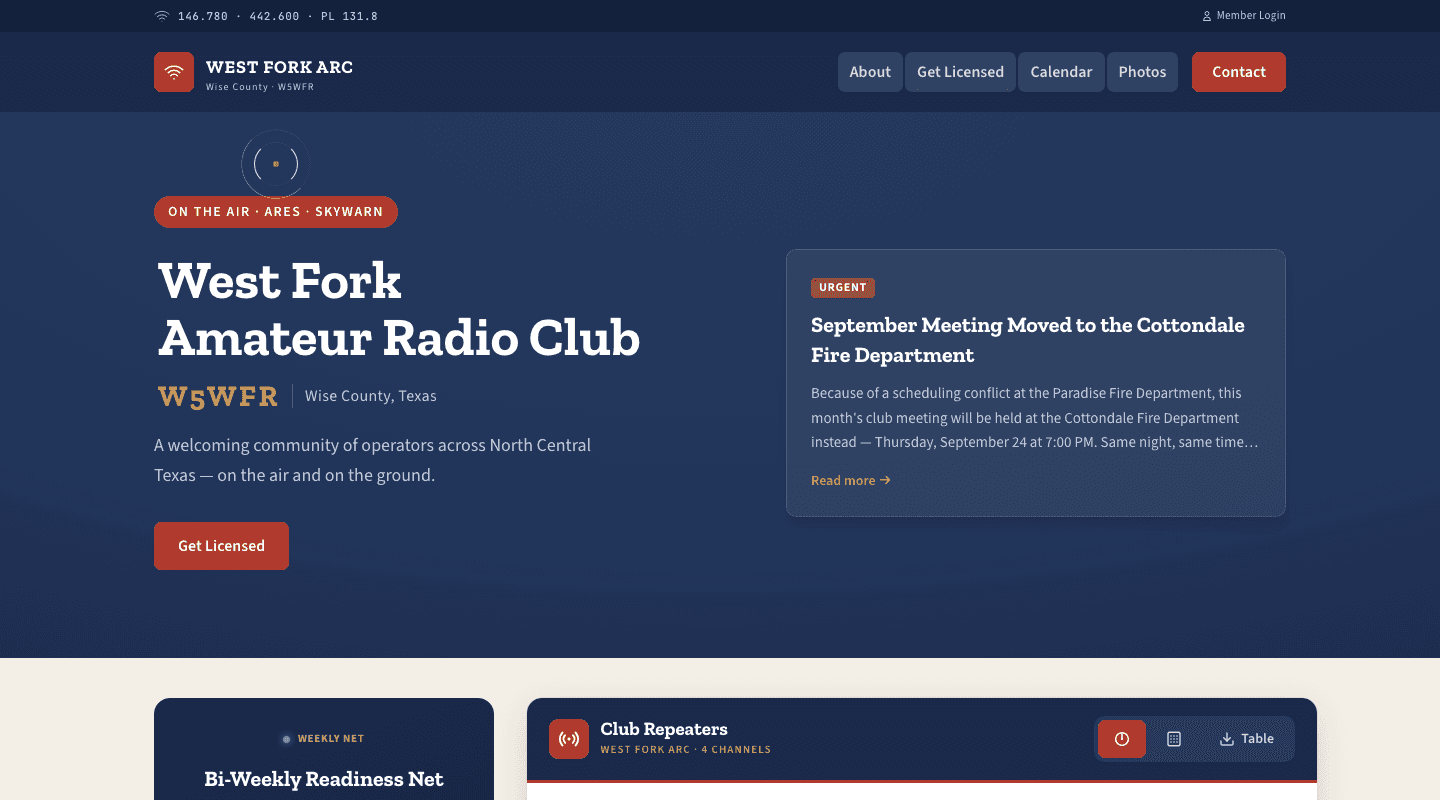
Meet the West Fork Amateur Radio Club
If you live in Wise County, Texas, the West Fork Amateur Radio Club (W5WFR) has your back, whether or not you've ever heard of them.
WFARC is an ARRL-affiliated club of licensed amateur radio operators across Wise County and the surrounding North Central Texas towns. When severe weather rolls in, their members are trained SKYWARN® storm spotters reporting conditions to the National Weather Service in real time. When normal communications fail, they stand up as volunteers with ARES®, the Amateur Radio Emergency Service. Their APRS weather stations feed live data to meteorologists and emergency responders across the county.
And they're good at it. At ARRL Field Day 2026, the club stepped up from a 4A to a full 5A operation: fourteen members ran 100% on generator, battery, and solar power for nearly 24 straight hours. They logged 2,078 contacts across six bands, reached 15 DXCC entities and 314 grid squares, and posted an official score of 8,021 points. That was their best Field Day ever, roughly 2,400 points ahead of the year before.
They also host Volunteer Examiner testing sessions, run a bi-weekly Readiness Net on the 2nd and 4th Mondays, keep four area repeaters on the air, and mentor new hams for free. Their monthly meeting is the 4th Thursday at 7:00 PM at the Paradise Fire Department, and guests are always welcome.
Curious about ham radio?
Visit wfarc.org, check the calendar, or look into getting licensed. The club's Elmers (mentors) will help you study and pass.
The Problem: A Club That Outgrew Its Website
WFARC's old website ran on an aging Drupal install, and the club's photos lived in a separate Piwigo gallery. Updating either one took someone technical. Like most volunteer organizations, the club doesn't have a webmaster on payroll. It has officers with day jobs, families, and a Field Day to plan.
That gap showed up in the details:
- Paper sign-in sheets at meetings and events that someone had to collect, read, and keep track of.
- Photos scattered between phones, inboxes, and a gallery that was hard to add to.
- Event updates that depended on one person having the time and the login.
- No easy way for members to put club events on their own calendars.
None of that is unusual. It's the normal state of affairs for thousands of clubs, churches, nonprofits, and small businesses. The tools that fix it exist. Historically, they just cost more than a volunteer organization can spend.
What We Built
We rebuilt wfarc.org from the ground up as a modern web application designed around how a radio club actually operates:
- Self-service content management. Officers manage announcements, events, pages, officers, and photo albums through a branded admin panel. No developer needed for day-to-day changes. Urgent announcements, like September's meeting moving to the Cottondale Fire Department, automatically take over the homepage hero.
- QR check-in. Every event gets a printable QR poster. Members scan it with their phone to check in, and can upload their photos straight into that event's gallery. No more hunting for a pen at the sign-in table.
- Cloud-backed photo galleries. Years of club history, including Field Day, Winter Field Day, community events like the Eighter From Decatur Bike Rally, and a gallery honoring the club's Silent Keys, all migrated from the old Piwigo gallery into fast, cloud-stored albums.
- A live calendar feed. Members subscribe once from Google Calendar or Apple Calendar, and new club events show up automatically.
- An interactive Repeater Tuner. All four club repeaters with frequency, offset, and PL tone, in analog, digital, and printable table views.
- Weather and emergency resources. SKYWARN, ARES, and APRS information front and center, because that's the club's mission.
- Get Licensed. License-class guides plus training and testing sessions pulled straight from the club's event calendar.
- PDF attachments on announcements and events for agendas, flyers, and forms.
Under the hood, it's the same caliber of engineering we deliver to enterprise clients: containerized and deployed to Kubernetes with GitOps, Redis-backed caching and rate limiting so the site stays fast when Field Day traffic spikes, SEO metadata and sitemaps, and redirects from every legacy wfarc.org URL so the club didn't lose a drop of its search ranking in the cutover. To date, it has shipped twenty production releases.
How We Built It: DRIVING the Machine
This is the part we most want other organizations to hear.
The first commit landed on June 29, 2026. Four days later, on July 2, the club announced the new site to its members, with the CMS, QR check-in, event photo galleries, the Piwigo migration, and calendar feeds already live. wfarc.org was cut over to the new platform on July 12. Since then we've kept shipping: news pages, announcement-driven homepage alerts, and PDF attachments.
That pace is possible because we DRIVE AI-assisted development. It doesn't drive us.
Here's what that looks like in practice. We gave an AI coding agent the job of producing the first draft of the site, working from the old site's content and the design direction. It drafted a full set of pages and components fast. It also handed back code that didn't build: a stylesheet ordering bug and a mismatched component name that would have taken down every page.
We caught both, fixed them, and logged them, along with a grade and specific tuning notes, in an agent changelog that lives in the repository. Every turn since then has followed the same loop. The AI drafts, a human engineer reviews, and the definition of done is a passing production build, not "the agent said it's finished."
The Secret Sauce Hasn't Changed: Human Judgment + AI Speed
AI writes code faster than any developer alive. It doesn't know a radio club, it doesn't own the outcome, and it will cheerfully tell you something works when it doesn't. Experienced engineers driving the AI, reviewing its work, and setting the bar for "done" is what turns raw speed into software you can trust.
The result is a codebase that went through security review (we closed a QR-token exposure and a rate-limit bypass before launch day), runs on production-grade infrastructure, and is documented well enough that the next engineer, human or AI, can pick it up cold.
Enterprise-Grade Is No Longer Enterprise-Only
For years there were two kinds of websites. Large organizations got custom applications, real infrastructure, and engineering teams to keep them running. Everyone else got a template and a prayer.
AI-empowered development collapses that gap. The work that once demanded a team of specialists and a six-figure budget can now be delivered by a small, experienced crew moving at AI speed, without cutting corners on security, performance, or maintainability. That changes who gets access to serious technology:
- Nonprofits and community organizations can have tools built around their mission instead of bending their mission around a template.
- Small businesses can afford custom software that fits how they actually work, instead of paying for five SaaS subscriptions that almost fit.
- Volunteer-run groups can finally hand day-to-day updates to the people who know the content, with no developer bottleneck.
WFARC is proof. A volunteer radio club in Wise County now runs on the same caliber of platform we'd build for a Fortune 500 client, and their officers can run it themselves.
Thank You, WFARC
To the officers and members of the West Fork Amateur Radio Club: thank you for trusting us with your home on the web, and for everything you do on the air and on the ground for North Central Texas. We're proud to have "Powered by NoLimitz" in your footer.
If you're anywhere near Wise County, go meet them. Check in on the Readiness Net, drop by a meeting on the 4th Thursday, or start studying for your Technician license. 73.
Your Organization Deserves Enterprise-Grade, Too
Whether you're a nonprofit, a community club, or a growing small business, the technology gap is closing fast, and we're DRIVING the machine that closes it. Tell us what's slowing your organization down, and let's build something extraordinary together.
Building an AI assistant, agent, or chatbot for your business?
We help you get it from prototype to production — with the observability and governance layer built in from the start.